
After a couple of blockbuster months, equity markets were more subdued in November, while Asian markets ended mostly in the red. In the US, the S&P 500 gained 0.3%, while the Nasdaq Composite declined by 1.5% as tech stocks retreated from elevated levels. The numbers, above, mask considerable volatility, as the Nasdaq slid 3% during the first week of the month, its worst weekly performance since April’s ‘tariff tantrum’. Across the pond, both London’s FTSE 100 and the Euro Stoxx 50 made slight gains, closing 0.4% and 0.1% higher respectively. Asian markets retreated, with Japan’s Nikkei 225 ending 4.1% lower, while Hong Kong’s Hang Seng declined by 0.1%. The Shanghai composite declined by 1.6%.
Where commodities are concerned, gold had yet another strong month, rising by almost 6%, though paling in comparison to silver, which was up 16%. Brent crude declined by almost 3% and is now down more than 15% YTD.
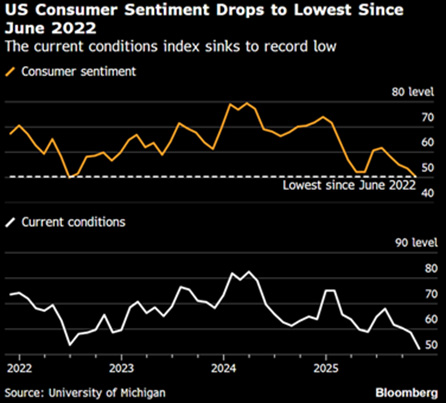
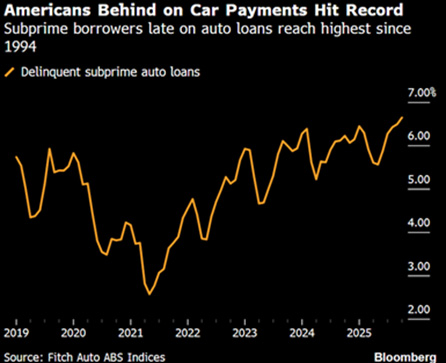
Overall, November was a relatively quiet month in terms of economic data, largely due to delays caused by the US government shutdown which turned out to be the longest on record. Amongst other data, private job’s numbers were strong, but US consumer sentiment continued to decline, hitting a 3-year low with persistent price increases. Once again, the government shutdown was cited as the main reason for these declines. Evidence of personal finance struggles is also evident in the percentage of Americans falling behind on their car payments, hitting the highest levels since 1994.
Outside the US, performance was equally strong. Though the FTSE 100 gained 4.1%, and the Euro Stoxx 50 gained 2.4%, both pale in comparison to Japan’s Nikkei, up 16.6% during October, after election results that point to a more dovish policy stance going forward. This also led to concerns over stimulus, sending bond yields higher and the Yen lower. A notable laggard, Hong Kong’s Hang Seng, declined by 3.5%, as China and the US, the world’s 2 largest economies, briefly renewed their trade-spat before extending their existing truce for another year.
Looking at commodities, the price of Brent Crude declined by 2.9%, as OPEC signalled more production increases ahead, following similar hikes in October and November; and a ceasefire, albeit fragile, was established in the Middle East. Gold, up 3.7% for the month, breached $4,000/ounce for the very first time, driven by safe haven demand, a weak yen, and the US government shutdown (which is on the verge of being the longest in history), but experienced notable intra-month volatility as it rallied north of $4,300, before retreating sharply towards the end of the month.
With the bulk of S&P500 companies reporting their Q3 results, several datapoints proved interesting. CEOs continue to point towards resilient consumer spending, but evidence is mounting that this is driven by the top income brackets only and could rapidly change in the event of a market sell-off. Job numbers also remain concerning, with private companies cutting 32 000 jobs in September, the biggest decline in more than 2 years. After the predictable Fed rate cut last month, attention now turns to the December meeting, with odds of another cut dropping notably following hawkish tones from the Fed, as inflation remains sticky above the Fed’s target.
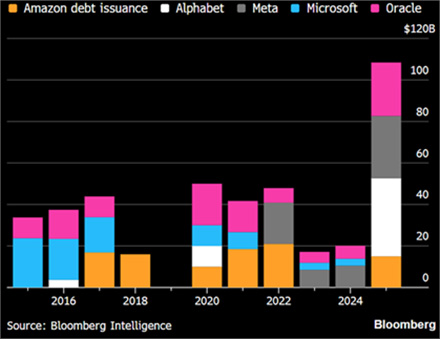
Investors still had plenty information to digest, though, with big tech’s spending spree blowing previous CAPEX plans out of the water. Investors grew concerned that an increasing portion of this CAPEX spend is being financed by debt, rather than free cash flow. The five major big spenders on AI — Amazon, Alphabet, Microsoft, Meta and Oracle – have raised a record $108 billion in combined debt in 2025, more than three times the average over the previous nine years, according to data compiled by Bloomberg Intelligence.
Politically, the divide across the US remains meaningful, and was on full display again this month. In NYC, arguably the centre point of the Western capitalistic system, a self-proclaimed socialist was elected as its new mayor.
From a geopolitical perspective, there were also several important developments. The US ratcheted up tensions against Venezuela which placed its entire military on alert; tensions between Japan and China simmered; and Japan reaffirmed plans to deploy missiles on an island near Tawain.
South Africa
Bucking the global trend, the JSE All Share index had another strong month, closing 1.6% higher. This return rises to 3.1% when measured in USD, thanks to another strong month for the ZAR, which gained 1.3% against the Dollar.
This was in no small part thanks to the official adoption of a lower inflation target of 3%, replacing the 3-6% band that has been in place since 2000. The rand strengthened below 17 per dollar for the first time since February 2023, hitting its strongest level in almost three years, on expectations the Central Bank will hold interest rates higher for longer to subdue price increases. Stocks and bonds also rallied after a mid-term budget update that included an improving fiscal outlook, prompting S&P to raise SA’s credit rating for the first time in 2 decades.
James Hayward BEng (Civil) CFA
Fund Manager
James (JD) is a fund manager of Flagship’s global funds, having joined in 2021 as an equity analyst. At the completion of his degree, JD worked in the engineering and fintech start-up industries while pursuing further studies in investments. JD holds an Engineering degree from Stellenbosch University and is a CFA charter holder.