

24 Jun Looking Beyond Familiar Markets: Why Investors Mistake Familiarity for Safety
Most investors believe their decisions are rational. Yet decades of behavioural-finance research suggest our choices are often shaped by psychological biases that operate below conscious awareness, and one of the most persistent is our tendency to favour the familiar. Whether choosing where to live, what to eat, or where to invest, people gravitate towards what they know. Familiarity provides comfort, comfort creates confidence, and confidence feels like safety. The challenge is that familiarity and safety are not always the same thing.
Why familiarity matters more than we think
In Thinking, Fast and Slow, Nobel laureate Daniel Kahneman (2011) describes two modes of thought. System 1 is fast, intuitive and automatic, leaning on familiarity and emotion to navigate everyday life; System 2 is slower, analytical and deliberate. These shortcuts are usually efficient, but they can mislead us precisely when decisions are complex and consequential; exactly the conditions under which we invest. Sound investing often means engaging System 2 to challenge assumptions that feel comfortable but are not optimal. The pull towards familiar markets is a textbook example: what feels safe is not always what is most diversified.
The familiarity trap
In investment circles this is known as home bias, the tendency to allocate a disproportionate share of wealth to one’s domestic market despite the well-documented benefits of global diversification. And the pattern persists. Even US investors, whose market is the largest in the world, hold around 80% of their equity at home, despite the US making up only about 60%¹ of global equity-market value, according to the IMF’s most recent global investment survey. If the pull is that strong where the home market is most of the world, it is far stronger in markets that represent only a sliver of it. The puzzle has not faded with time either: even as the barriers to investing across borders have fallen, investors stay concentrated at home, and where they do venture abroad, they tend to favour countries that feel close – ironically the very markets offering the least diversification benefit.
For South African investors the bias is especially powerful. Local companies are easy to understand: their products are visible, their results fill local media, their executives appear on local business programmes. That familiarity creates a perception of knowledge and control, yet the comfort it creates can quietly limit opportunity.
Why familiar feels safe
Behavioural finance offers four complementary explanations.
Familiarity bias. People prefer what they recognise. Investors will often hold the company down the road, or the brand they grew up with, not because it’s the better investment but because it’s the one they know. The comfort is real – but feeling more certain about a company is not the same as taking on less risk.
The availability heuristic. We judge how important something is by how easily it comes to mind. For South African investors, local news and company announcements fill the daily information flow, so home-market developments feel weightier than they really are inside a global portfolio. What is easy to recall is not necessarily what matters most.
Ambiguity aversion. Given the choice, people favour a risk they can measure over one they cannot – even when the two are identical. Distant, less familiar markets feel murkier, so local assets seem safer by comparison, even when the risks at home are similar or greater.
Status quo bias. People tend to stay with what they already hold. In a portfolio, that inertia helps explain why so many investors remain concentrated at home long after the case for diversification has become hard to ignore.
The cost… and the opportunity
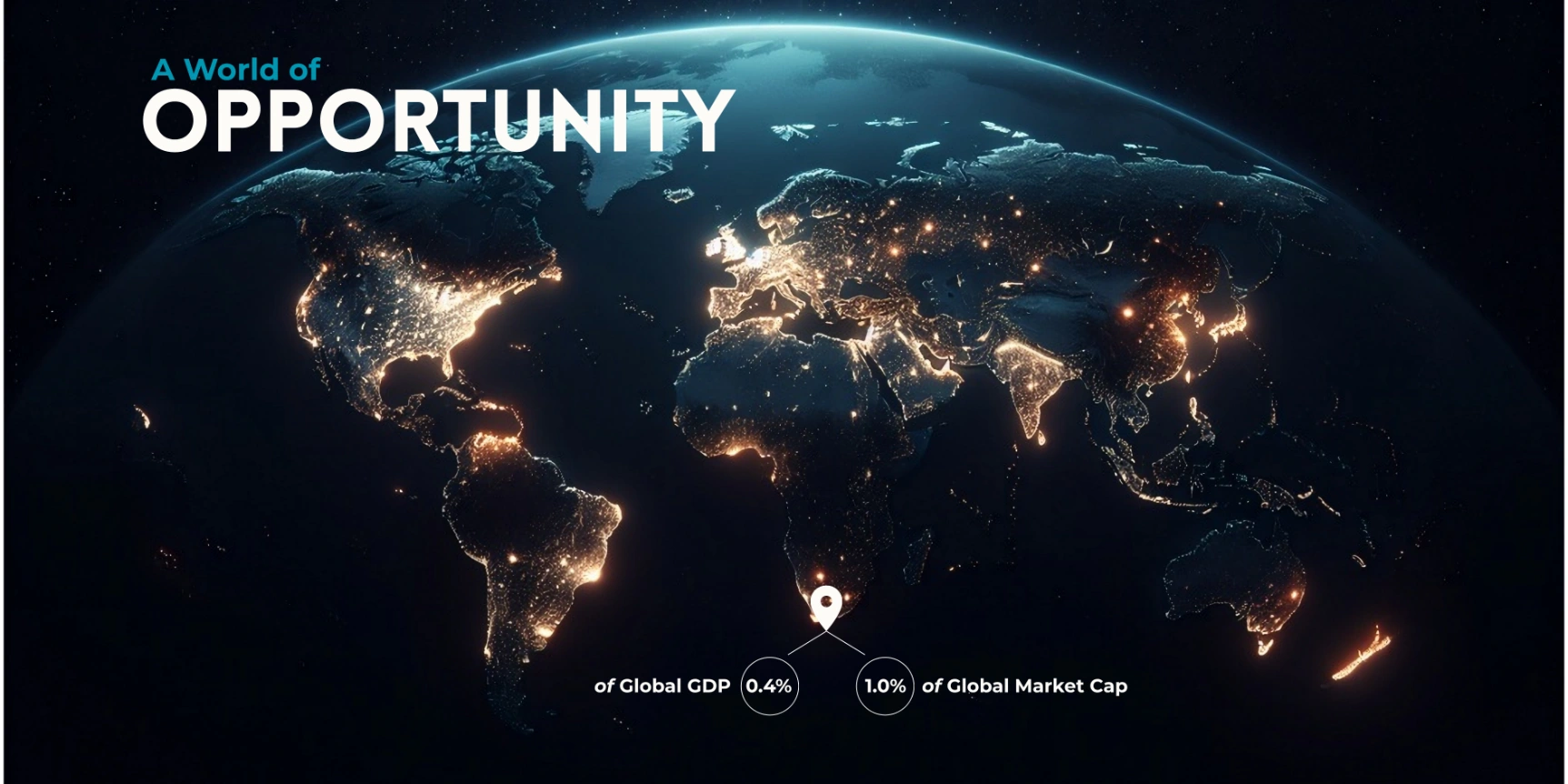
The issue is not that South Africa lacks attractive opportunities; it is that investors who restrict themselves to the familiar may unintentionally limit their opportunity set. French and Poterba framed the cost in a way that still holds: a portfolio concentrated at home is, in effect, an implicit bet that your domestic market will out-earn the rest of the world, year after year. Few investors who are disproportionately invested in South Africa, relative to the size of the global opportunity set, are consciously aware of the bet they are making. The scale of what sits outside the familiar is easy to underestimate. South Africa generates roughly 0.4% of global GDP, and the JSE, for all its quality, accounts for only about 1% of global equity-market value, leaving close to 99% of the world’s listed opportunity beyond a home-heavy portfolio.
Home bias is no longer simply a geographic issue. It is increasingly a sector issue. Many of the structural growth themes shaping the global economy – artificial intelligence, semiconductors, cloud computing, biotechnology, and digital infrastructure are largely absent from the South African market. Investors who remain heavily concentrated at home may not only be limiting geographic diversification; they may also be missing exposure to some of the most important drivers of future economic growth.
Looking beyond familiar markets
The goal is not to abandon local opportunities. South Africa remains an important part of many portfolios. It is simply to ensure that familiarity does not become a constraint – to distinguish, in Kahneman’s terms, between the System 1 comfort of the familiar and the System 2 discipline of genuine diversification.
Global investing, then, is not only about reducing risk; it is about expanding opportunity. It opens access to thousands of companies across multiple sectors, geographies, economic cycles, and structural growth trends not yet represented at home.
The most successful investors recognise that the world is far larger than the markets they know best. As the opportunity set expands, investors must look beyond geography alone and assess businesses, sectors and economic drivers across a far broader landscape. Opportunity often lies beyond what feels familiar.
Authored by:
Philip Short
Fund Manager, Flagship
Philip Short is a Fund Manager at Flagship Asset Management, a specialist global investment manager based in Cape Town. This article was inspired by discussions following his presentation at Meet the Managers 2026 and explores the behavioural biases that influence how investors allocate capital.
Footnote ¹:
The US share of global equity-market value is approximate and moves with the market; “about 60%” is consistent with the United States’ weighting in the MSCI All Country World Index (ACWI) through 2023–2024. As a market-capitalisation-weighted figure, it drifts over time with relative market performance.