


The US’s S&P 500 benchmark closed the month unchanged. This was not the case for the tech-heavy Nasdaq, which declined by 3.2%. On a stock level, however, there was some extreme volatility, such as IBM’s single day 26% decline, it’s largest since 1968, highlighting the market’s skittishness in the current environment.
In the UK, London’s FTSE 100 enjoyed a strong month, gaining 3.6%. Europe’s Stoxx 50 was more subdued, gaining only 0.5% for the month. The moves in the East were more volatile, with Japan’s Nikkei 225 losing 8.1% while, on the opposite end of the spectrum, Hong Kong’s Hang Seng Index was a big winner, gaining 13.5%. Emerging markets struggled, with the MSCI EM index declining by 3% during the month. This was, to a large degree, driven by the extreme levels of volatility seen in the South Korean and Taiwanese markets. At one stage, the Korean Kospi tumbled 11%, two days in a row, to print a record two-day decline. Even after staging a massive single session 18% recovery, the index was still down more than 20% for the month.
The US Federal Reserve again decided to keep rates unchanged, notwithstanding three members dissenting in favour of a hike. This led to a sharp selloff in US long bonds, sending yields to 5.2%, the highest levels since 2007, as the market questioned new chairman Warsh’s resolve in getting inflation back to the 2% target level. The decision to keep rates steady came after a softer than expected inflation print of 3.5% earlier in the month.
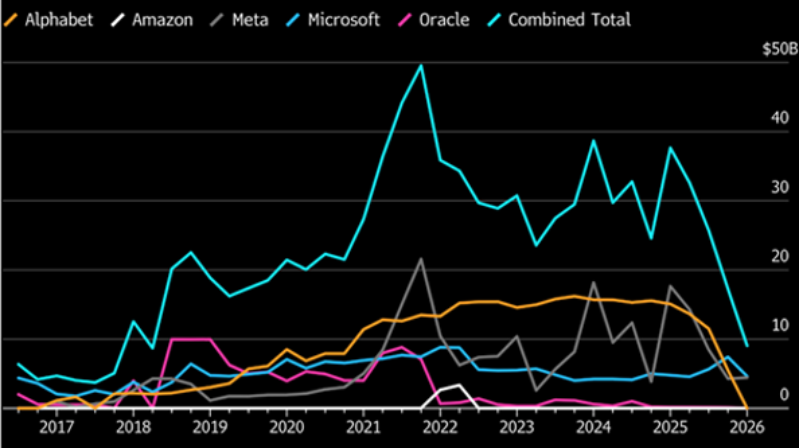
At a company level, attention was firmly fixed on a highly anticipated earnings season. Big banks set the tone, with the five largest US banks recording an almost 40% profit surge from a year ago. The key test was always going to be the capital expenditure numbers reported by the hyperscalers, and currently, there is very little evidence of this spending slowing down. All this must come at the cost of something else, and right now, that cost is drastically reduced share buybacks. In recent quarters, there has been a clear decrease in share buybacks. With Alphabet going free cash flow negative this past quarter, plus Meta’s free cash flow plunging 91% year-over-year, those numbers are unlikely to increase as long as the capex boom remains intact.
Graph 1: Money Spigot Starts to Run Dry
Quarterly share buybacks for five big tech firms through Q1, 2026