


Most global equity markets finished August in the green. In the US, the S&P 500 ended 2.7% higher, while the Nasdaq Composite gained 4.0%. In the UK, markets were slightly more subdued, with the FTSE 100 ending 0.2% higher, while the Euro Stoxx 50 gained 1.0% in the EU. The picture was mixed in the East, as Japan’s Nikkei 225 gained 3.1%, while Hong Kong’s Hang Seng was a notable laggard, closing 1.0% lower. South Korea’s Kospi index, which has become a barometer of AI buildout volatility, finished the month 3.5% higher.
Nvidia delivered another set of blockbuster results, with both earnings and forward guidance well ahead of street estimates. Management noted that their strong forward guidance was still supply-constrained and would otherwise have been even higher. Capex spending in AI shows no signs of slowing, and companies are increasingly turning to debt and equity markets to finance the build-out. Intel is a case in point, now issuing new public stock for the first time since its 1971 listing. Its $20 billion offer was easily met, with demand exceeding $100 billion.
Despite some blockbuster technology earnings, the dominant market narrative over the past month was the renewed rise in global bond yields. US inflation remains stubbornly elevated, while national debt continues to balloon amid persistent budget deficits and little political appetite to alter the fiscal trajectory. Investors are consequently demanding greater compensation for holding long-dated government debt. The extraordinary capital requirements of the AI build-out are adding to this pressure, with hyperscalers raising billions in debt and increasingly competing with governments for investor capital. Together, these forces pushed the US 30-year Treasury yield to its highest level in almost two decades, while new 10-year Treasury debt was issued at its highest yield since 2007.
The US Treasury blinked, announcing plans to increase buybacks of longer-dated bonds in an effort to ease market pressure and contain yields. However, markets were unconvinced. The move also drew sharp criticism from legendary investor Stanley Druckenmiller, Treasury Secretary Scott Bessent’s former mentor, who called the intervention a mistake and warned: “Governments defending prices against fundamentals always lose.”
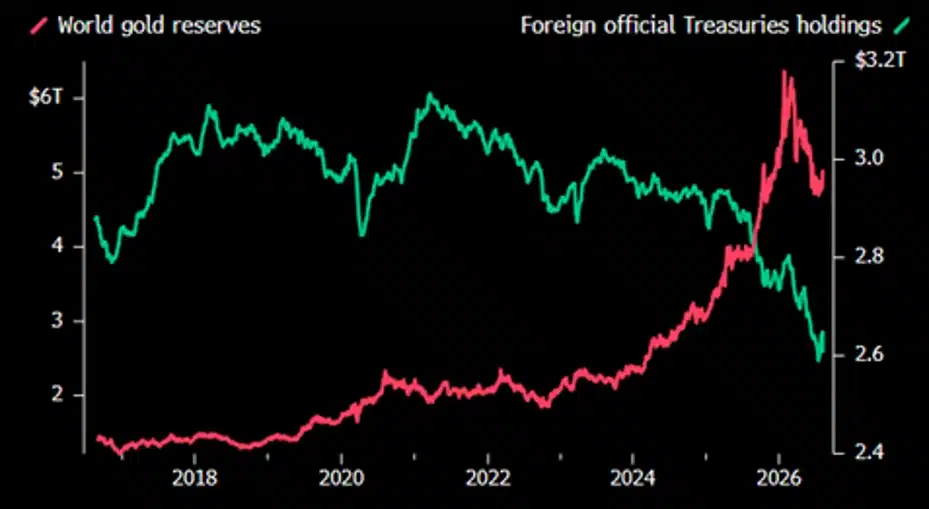
These concerns have sparked a resurgence in gold, with bullion staging a 9.7% rally over the month. But the shift extends beyond the recent price move. Central banks have been steadily increasing their exposure to gold while reducing their holdings of US Treasuries – potentially weakening what has historically been an important source of structural demand for US government debt.
Graph 1: Central Banks Are Preferring Gold to Treasuries | Shift highlights drying up of key source of sustained demand for bonds.