February delivered a wide variance of results for global equities. In the US, both the S&P 500 and Nasdaq Composite declined, dropping 0.8% and 3.3% respectively. In contrast, the small cap Russell 2000 enjoyed a green month, ending 0.8% higher. London’s FTSE 100 was strong, gaining 7%, while the Euro Stoxx 50 ended 2.4% higher. Japan’s Nikkei 225 had another very strong month, closing 10.4% higher. Hong Kong’s Hang Seng Index was relatively weak, closing 2.8% lower.
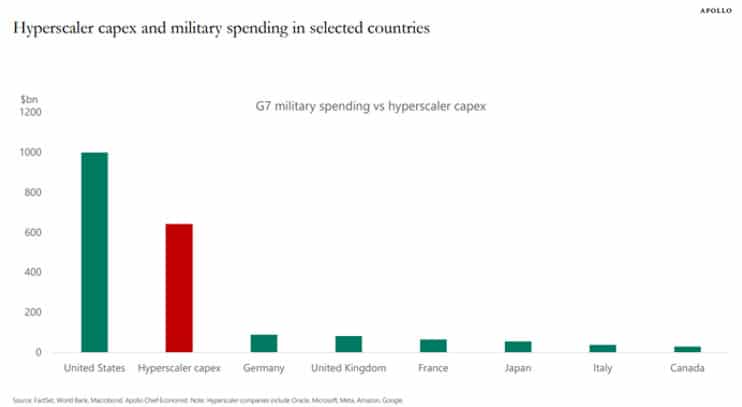
Economic data released this month painted a mixed picture of the current environment. Hyperscaler capex numbers continue to expand at an astonishing rate. Between Google, Meta, Microsoft and Amazon, capex guidance has now ballooned to roughly $625 billion vs prior estimates of $475 billion. Amazon on its own has upped guidance from an estimated $145 billion to about $200 billion. To provide some context, Russia’s combined military and police budget for 2026 is $212 billion. It is also more than the combined military spending of the UK, France, Germany, Japan, Italy and Canada. To fund these spending levels, the world’s largest companies are increasingly looking at credit markets, with Google offering a 100-year maturity bond, the first time a company has done this since Motorola, about 3 years before the dot.com crash. This level of spending has investors on edge, as capex discipline and monetization ability becomes paramount.
Despite the strong growth driven by these AI hyperscalers, there were some signs of a cooling US economy, as US GDP expanded at a fairly muted 1.4% in Q4 2025, well below the prior quarter’s 4.4% and estimates of 2.8%. The caveat here, is that the government shutdown would have affected this number substantially. US Job openings also fell unexpectedly in December to about 6.5 million, much lower than the estimate of 7.25 million and the lowest levels since 2020. January layoffs then reached 108 000, the highest January number since 2009. January, however, also saw the addition of 130 000 jobs, the strongest monthly number in more than a year. From the retail side, sales data underwhelmed with contraction across 8 of the 13 categories monitored. The economic picture remains complex!
To add some confusion, there was also a key finding from the US supreme court, as they struck down Trump’s tariffs in a 6-3 decision. This further complicates the outlook over the next couple of months.
February was again dominated by global geopolitical instability, this time in the Middle East. The buildup of US forces proved to be more than just posturing, as a series of offensive strikes brought the Islamic regime of Iran to its knees, with a large number of senior leaders, including Supreme Leader Ayatollah Ali Khamenei, being killed on the very first day of the conflict. Predictably, this has led to energy futures spiking, with potential knock-on effects for global inflation. The ultimate effect will only be known as the full scale of the operation becomes clear.
South Africa
The local market continued its winning streak, gaining 7% in ZAR during the month, once again driven by the Resource’s index which closed the month 13.4% higher. South Africa’s Finance Minister delivered one of the strongest budgets in recent years, with steadfast progress on fiscal, monetary and structural reforms – supported by a benign global backdrop and domestic political stability – resulting in improved balance sheet dynamics: a narrowing deficit; lower debt service costs; and limited revenue and spending changes.
James Hayward BEng (Civil) CFA
Fund Manager
James (JD) is a fund manager of Flagship’s global funds, having joined in 2021 as an equity analyst. At the completion of his degree, JD worked in the engineering and fintech start-up industries while pursuing further studies in investments. JD holds an Engineering degree from Stellenbosch University and is a CFA charter holder.