Despite an abundance of activity and news, to close out a volatile quarter, markets were fairly subdued in June. The S&P 500 declined by 0.9%, while the Nasdaq Composite declined by 2.8%, driven mainly by a pullback in semiconductor stocks and the AI trade. However, both recorded their strongest quarters in the last 6 years. The small-cap Russell 2000 was a standout performer, gaining 3.7% during the month. European returns were surprisingly strong, with the Euro Stoxx 50 index ending the month 4.6% higher. Japan’s Nikkei was also strong, gaining 5.7%, while Hong Kong’s Hang Seng was a notable laggard, declining by 8.5% during the quarter. Special mention must be made of the Philadelphia Semiconductor Index, which rose 92% over the past 3 months, to record its best-ever quarter, as investors increasingly bet on positive returns from AI adoption.
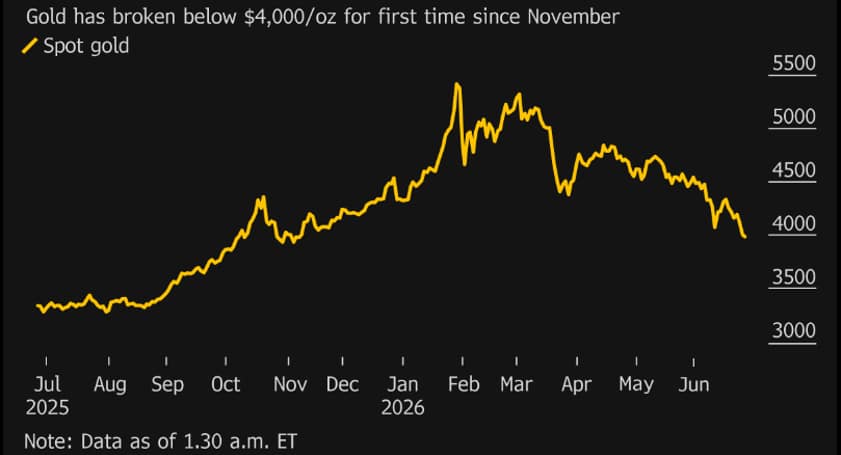
There was much more volatility in the commodity market, where Brent crude oil prices declined by 20.8% during the month and is now down 38.4% over the last 3 months – back to pre-war levels, despite only a portion of flows through the Strait of Hormuz being reinstated. Gold, meanwhile, dropped 11.7% during the month and 14.1% over the quarter, recording its worst quarter in 13 years following exceptionally strong performance in 2025 and Q1 2026. This has been driven by market expectations of the US Fed targeting interest rate hikes toward the end of the year, making US Treasury yields more appealing and the US Dollar (gold’s pricing currency) stronger. After falling more than 20% from a recent high, gold entered a bear market for the first time in 4 years.
Graph 1: Multi-Year Rally in Gold Grinds to a Halt
Gold has been below $4,000/oz for the first time since November.
Source: Bloomberg as at 30 June 2026
In terms of monetary policy, there were rate hikes from the European Central Bank (its first in 3 years), as well as the Bank of Japan, to a 31-year high of 1%. Both of these moves are in response to inflationary concerns brought about by the war in Iran. Traders are bracing for further hikes in Japan, as the Yen is currently at its lowest level against the USD since 1986. All of Japan’s energy imports are priced in Dollars, further stoking energy inflation.
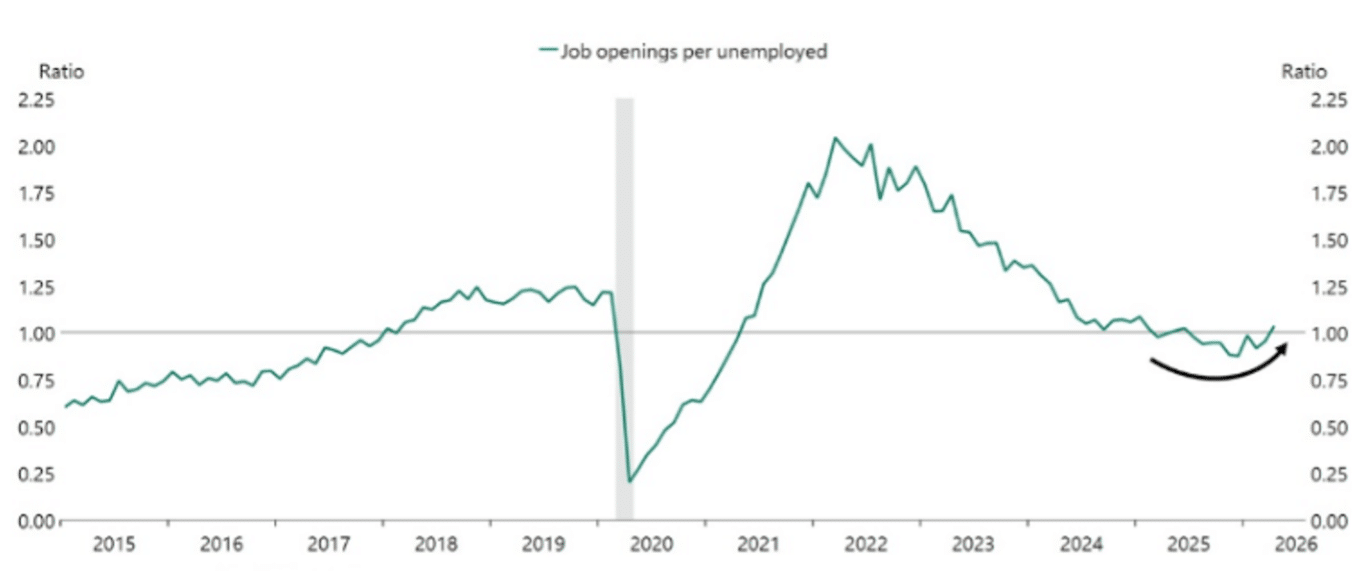
Graph 2: Job openings per employed
The number of job openings per unemployed has started to rise. Likely driven by AI-powered business formation, resulting in more job openings.
Source: US Bureau of Labour Statistics (BLS), Macrobond, Apollo Chief Economist
Rates in the US were kept steady, as new Fed Chair Warsh presided over his first Fed meeting. Consensus views were more hawkish than expected, with governors pencilling in one rate hike in 2026. US jobs numbers continue to be remarkably resilient, and GDP growth for Q1 was recently upgraded from prior estimates, providing more room for the Fed to be aggressive in its inflation-taming efforts. Some of the latest data, however, points to subdued inflation. Has Jerome Powell signed off with a perfect balancing act? The verdict is still out.
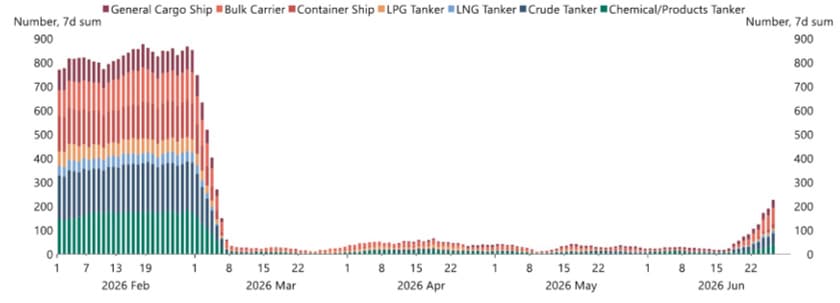
In geopolitics, the Middle East situation remains front and centre. While progress has been made towards a peace agreement, there remain significant barriers to overcome, with Iran’s nuclear ambitions reportedly being the stickiest issue. A fragile ceasefire remains in place, interrupted by the odd barrage of strikes from both sides. This has led to a gradual reopening of the Strait of Hormuz, with the oil price giving up all its war-era gains.
Graph 3: Ships passing through the Strait of Hormuz
Source: Bloomberg, Macrobond, Apollo Chief Economist
In the UK, the political hamster wheel keeps spinning and, after Keir Starmer’s resignation, they are now set to have their seventh leader in only 10 years. The UK continues to battle a number of issues, including stagnant growth, inflation, and immigration policies.
South Africa
The JSE was a relative underperformer this month, declining by 3.7%, and is now down 3.0% over the year in rand and down 1.9% in dollars.
There was some good news: Fitch upgraded SA’s credit rating to BB. All 3 major ratings agencies now have SA sovereign debt 2 notches below investment grade…but at least now moving in the right direction. There was also some bad news: S&P lowered its economic growth forecasts for South Africa, and consumer confidence continued to decline, partially due to steep fuel price increases. Lastly, the xenophobic violence gripping parts of the country is certainly not contributing to our standing on the world stage.
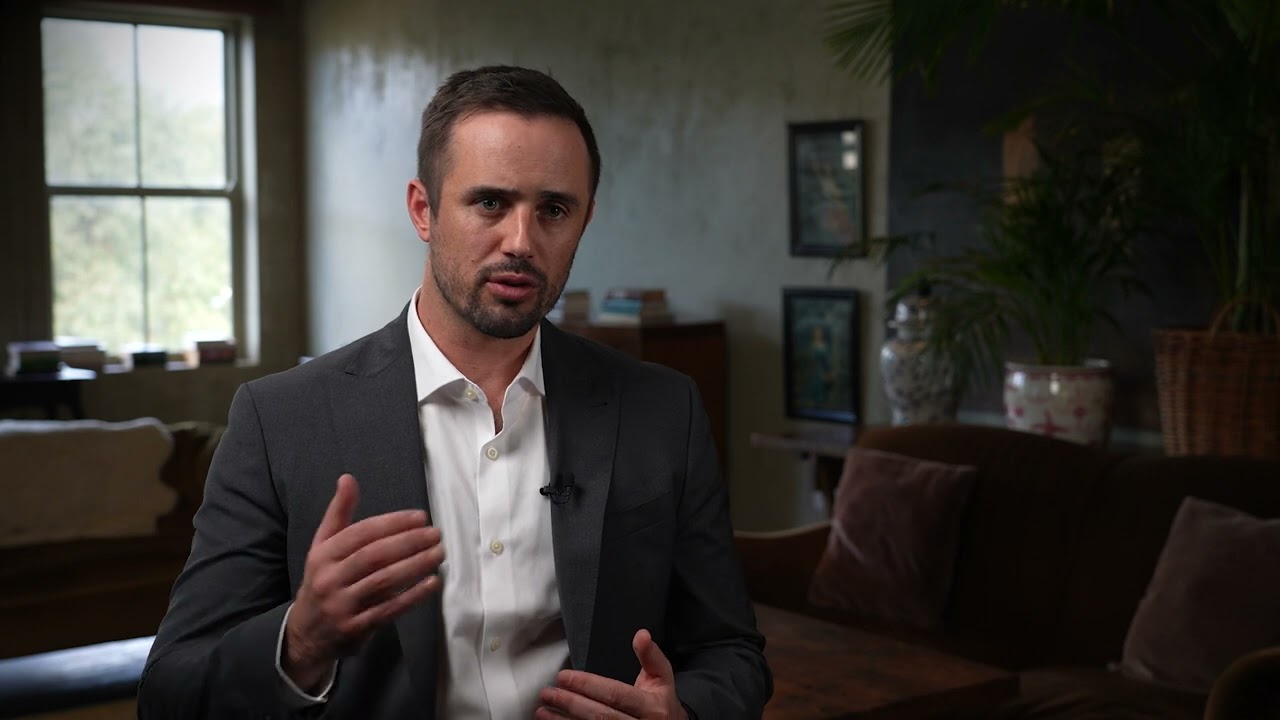
James Hayward BEng (Civil) CFA
James Hayward (JD) is a Fund Manager at Flagship, a specialist global asset manager, where he manages global investment strategies, with a particular focus on global equity research and portfolio construction. He joined Flagship in 2021 as an equity analyst and has played an integral role in developing and implementing the firm’s investment process.
Before entering investment management, James worked in engineering and the fintech start-up industries. During this period, he pursued further studies in investments. He developed a strong analytical foundation and problem-solving approach, which supported his move to Flagship in 2021 as an equity analyst.
James holds a Bachelor of Engineering degree in Civil Engineering from Stellenbosch University and is a CFA Charterholder.