

Monthly Commentary March 2026

February delivered a wide variance of results for global equities. In the US, both the S&P 500 and Nasdaq Composite declined, dropping 0.8% and 3.3% respectively. In contrast, the small cap Russell 2000 enjoyed a green month, ending 0.8% higher. London’s FTSE 100 was strong, gaining 7%, while the Euro Stoxx 50 ended 2.4% higher. Japan’s Nikkei 225 had another very strong month, closing 10.4% higher. Hong Kong’s Hang Seng Index was relatively weak, closing 2.8% lower.

March ‘26 saw a meaningful pullback in equity markets across the globe as the conflict in the Middle East proved to be the main driver of performance. In the US, the S&P 500 was down 5%, while the Nasdaq composite declined by 4.7%. London’s FTSE 100 declined by 6.2% while the Euro Stoxx 50 lost 9.3%. There was plenty of pain in the East as well, as the Nikkei 225 declined by 12.7%, and Hong Kong’s Hang Seng finished the month 6.6% lower. South Korea’s Kospi, one of the world’s best performing markets over the past year, experienced its worst day on record, dropping 12% in a single session.

News flows this month was driven and dominated by the conflict in the Middle East and subsequent disruption to oil supplies, with the Strait of Hormuz mostly shut following the US-Israeli strikes that killed Iran’s Supreme Leader.
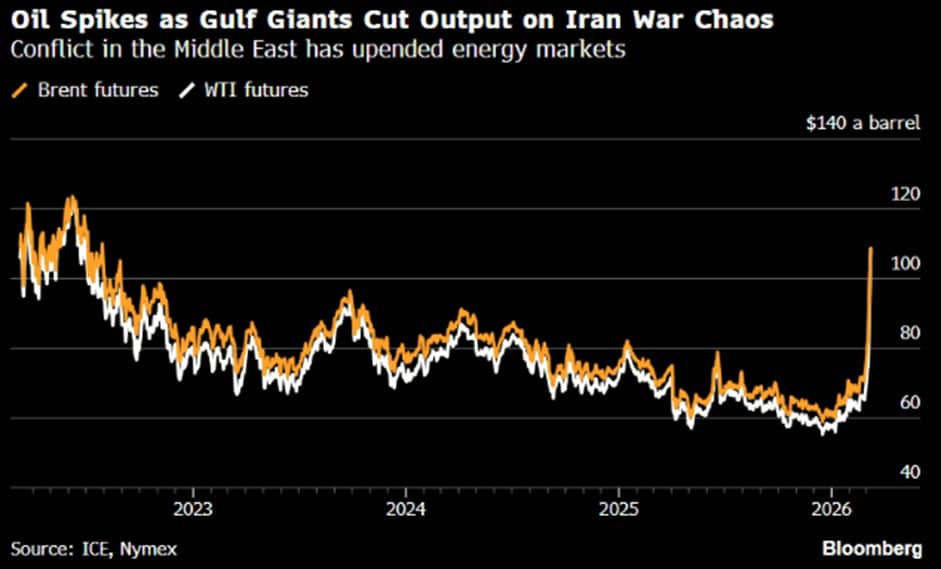

Inflation concerns have re-entered the equation. Brent Crude oil futures increased by 63.3% during the month, hovering around $120 per barrel at month end. The volatility was extreme, with prices touching $120 and $80/barrel within a 24-hour period. Sentiment was not helped by statements from IEA officials that oil supply disruptions are unprecedented in scale, leading to only its sixth emergency release during the organization’s 52-year history.

Renewed inflation concerns saw rates kept steady at the FOMC meeting by a vote of 11-1. Any chance of rate cuts for the year has (probably) been eliminated, with futures now pricing in a 35% chance of a hike by October. This lower likelihood of further rate cuts, and a search for liquidity, led to selling pressure on gold bullion, which declined by 11.6% during the month. The precious yellow metal experienced its biggest weekly drop since 1983.

Military escalations in the Middle East have been severe, with rhetoric around war shifting multiple times, making short-term predictions somewhat useless, with markets influenced more by social media posts than market fundamentals. One gets the feeling, however, that Iran’s hand for future negotiations gets stronger with each day, providing them incentive to reject ceasefire or peace deals put on the table. Trump, meanwhile, risks isolating the US, as he shifts between threatening allies and asking for their help.

To add additional volatility, private credit concerns have also surfaced, with several prominent names (including Apollo, Blackrock, Blackstone, Morgan Stanley) refusing to honour the agreed upon redemption schedule as fears of overspending in the AI space has debt investors on edge.

South Africa
South African equities were not shielded from March’s carnage. The JSE ALSI declined by 10.4%, while the JSE Resources index declined by 15.2%. Measured in Dollars, these returns are markedly lower, with the ZAR declining by 6.3% against the USD during the month.

Escalation in the Middle East is set to have a large local impact, given our reliance on imported refined petroleum products. Steep fuel price hikes will hurt both wallets and retail spending, while consumers must now also contend with higher-for-longer rates, given the likely spillover into higher inflation numbers, something the hawkish SARB will be closely monitoring.

James Hayward BEng (Civil) CFA
Fund Manager

James (JD) is a fund manager of Flagship’s global funds, having joined in 2021 as an equity analyst. At the completion of his degree, JD worked in the engineering and fintech start-up industries while pursuing further studies in investments. JD holds an Engineering degree from Stellenbosch University and is a CFA charter holder.